
Sacramento County: Tackling the Invisible Crisis of Social Isolation
Living in California's vibrant capital, it’s easy to feel surrounded by energy. But for many residents across Sacramento County, the dominant feeling isn’t connection—it’s isolation.
Recent health assessments across the county have brought a stark reality to light: Sacramento is grappling with the U.S. Surgeon General's identified "Epidemic of Loneliness." Far from just a "feeling," social isolation is now recognized as a significant public health threat, carrying health risks equivalent to smoking 15 cigarettes a day.
A Community Snapshot
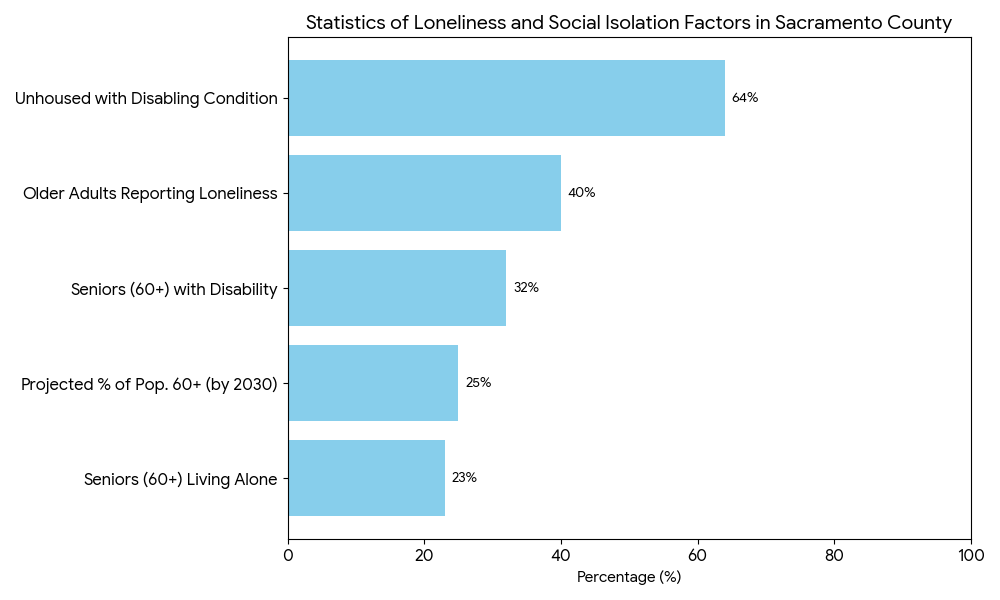
Local statistics illuminate the scope of this invisible crisis. The data shows that vulnerabilities are acutely felt by specific groups:
Why is This Happening?
Loneliness isn't just about "being alone"—it's often the result of structural, physical, and economic barriers that strip away a person's ability to participate in the community.
1. The "Dual Challenge" of Aging
For Sacramento’s seniors, isolation is rarely a choice. As we age in car-dependent neighborhoods, the loss of mobility and transportation effectively turns homes into islands. Major life transitions, such as retirement or the loss of a spouse, create a "subjective" isolation where individuals feel fundamentally disconnected from the world around them.
2. The Barrier of Access
For the 32% of seniors—and thousands of younger residents—living with a disability, the leading cause of isolation is a lack of equitable access. When local parks, transit, or community events aren't fully accessible, it creates a "forced withdrawal." This is often compounded by health stigmata, where the fear of judgment leads many to stay isolated to avoid the "social tax" of navigating public spaces.
3. Extreme Social Exclusion
For our unhoused neighbors, isolation is a form of "social death." Systemic marginalization makes many feel "invisible" to mainstream society. Combined with the fact that over 64% live with a disabling condition or PTSD, many individuals enter a "protective" withdrawal, avoiding social services because they no longer feel safe in group environments.
The Real-World Consequences
For Sacramento's healthcare systems, these numbers translate into physical ailments. Health networks like Kaiser Permanente and Dignity Health have prioritized "Social Support" because isolation is directly linked to a 29% higher risk of heart disease and a 50% increased risk of dementia.
Building Bridges
The challenge for Sacramento County will grow. By 2030, a quarter of our population will be over age 60. Addressing this epidemic requires more than clinical intervention; it requires community-building. We must strengthen local programs—from senior centers to volunteer networks—that facilitate true human connection.
